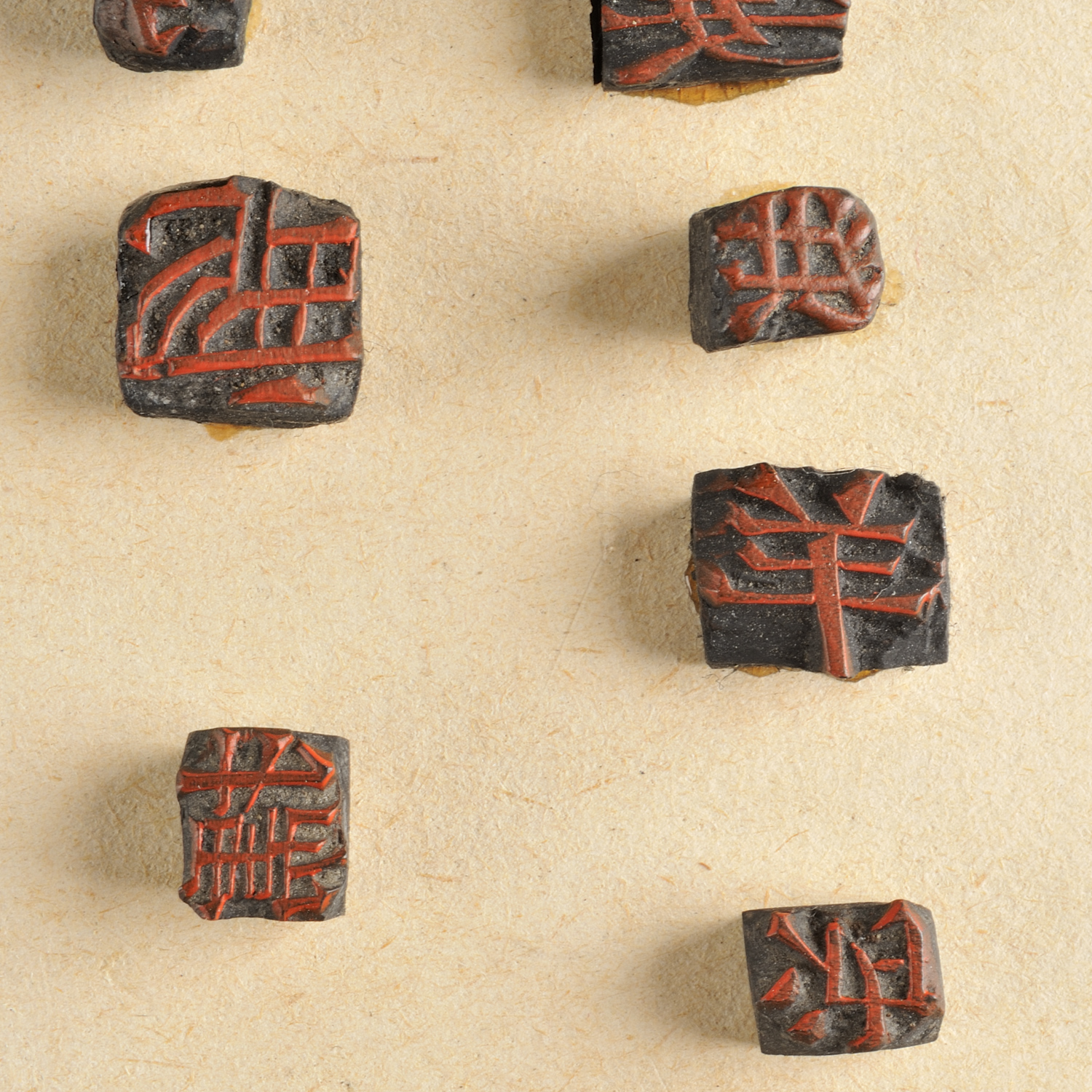
Wooden movable type used in Korea in the 18th century to print an edition of a text in Chinese.
History
As early as the 11th century, the Chinese were the first to try printing with baked clay or wooden types.
Two centuries later, in Korea, moveable metal types (bronze, copper or tin) were used for the first time. These types were produced using a sand-casting method.
Method of casting metal types
Inverted model letters are drawn on paper strips, which are then pasted to wooden sticks. The letters are carefully carved out in relief. These wood-cut letters are then pressed into a two-part mould made from sand and clay. The carved wooden letter leaves a negative impression in the sand. Molten metal is then poured into the assembled mould. It fills up the cavity left by the wood-cut letter and solidifies to become a type. The mould is opened and the metal type is removed. Before being used, the type has to be polished and the irregularities filed off. The metal types obtained by this process are square and flat.
Text composition in Korean or Chinese characters
A copper frame is used as a printing forme. The frame is coated with a layer of wax, which secures the types firmly to the frame. Another method of securing the types to the frame consists of filling the spaces between the types with scrap pieces of bamboo or paper. Inner guiding lines (sticks made from bamboo) for types are added on the frame. The text to be printed is assembled by arranging the letters (type) on the frame. This process is called composition. Traditional written Chinese is read from top to bottom and from right to left. The texts are therefore composed in the same manner.
Printing
Once the text has been composed, the printing frame is inked with a brush. A sheet of paper which has previously been coated with oil and humidified is placed onto to frame. The sheet has to be pulled tightly so as to prevent it from crumpling during the printing process.
The Jikji, is the oldest extant book printed with moveable metal type in the world. This Korean book on Buddha’s teachings, written in Chinese characters (hanga) is part of the collections of the Bibliothèque nationale de France.
The Korean script went through a reform in the 15th century. Chinese caracters were then remplaced with the Hangul, a new alphabet made up of only 28 letters (further reduced to 24).
This writing was simple and easy to learn. It is still considered as one of the most “economical” scripts in the world. However, just as Chinese, each Korean character is written in a block form. In Hangul, each block transribes a syllable and can therefore include several of the 24 basic letters. This difficulty is easily managed for handwritten documents. However, in typography, it requires the casting of hundreds of combinations and is therefore hardly any simpler than Chinese logograms.
Only one or two centuries after the printing of the Jikji, moveable metal type printing method dies out in the Far-East. Calligraphy and woodblock printing continue however to be used to reproduce texts and images. It is in the West that moveable metal type printing will be developed and will flourish.
Compared to Korean types, Western types show finer craftsmanship. They have a long shape, are more standardized and are cast with an adjustable hand mould. Instead of a brush, a machine, a hand-press built of wood, is used to exert pressure on the printing form. The result is of a higher quality as more ink is transferred onto the paper and more evenly as well.